
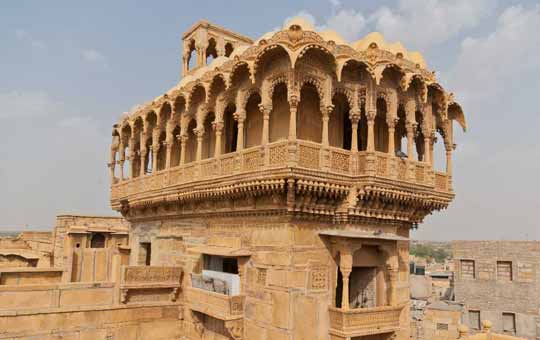
The golden sands of Jaisalmer whisper tales of romance, trade, ambition, and artistry. Known as the “Golden City,” Jaisalmer rises like a mirage from the heart of the Thar Desert, crowned by the majestic Jaisalmer Fort. Yet beyond its imposing walls lies another world—one of exquisitely carved havelis, each holding fascinating stories of the merchants and nobles who once called them home.
The Merchant Princes of the Desert
Centuries ago, Jaisalmer flourished as a vital stop along ancient trade routes connecting India with Central Asia and beyond. Wealthy traders, dealing in silk, spices, and precious stones, accumulated immense riches. With prosperity came the desire to display status, leading to the creation of grand havelis—ornate mansions that rivaled royal palaces in beauty and detail.
Among the most famous is Patwon Ki Haveli, a cluster of five havelis built by Guman Chand Patwa and his sons. Legend has it that the Patwa family wanted their homes to reflect not just wealth but artistic supremacy. Skilled artisans were brought from across regions, and no expense was spared. The result is a breathtaking complex adorned with delicate jharokhas, mirror work, and intricate carvings so fine they resemble lace in stone. It is said that each haveli was uniquely designed to reflect the personality of its owner.
A Haveli That Defied Convention
Equally captivating is Salim Singh Ki Haveli, known for its unusual structure. Built by Salim Singh, a powerful prime minister, this haveli carries a story of ambition and rivalry. According to local folklore, Salim Singh desired to build a structure taller than the fort itself to showcase his dominance. However, the ruling king disapproved, and the upper wooden floors were eventually removed. Despite this, the haveli remains striking, with its peacock-shaped roof and dozens of uniquely carved balconies, each telling a silent story of pride and power.
A Tale of Two Brothers
The story behind Nathmal Ki Haveli is one of creativity and competition. Commissioned by a royal minister, the haveli was built by two architect brothers who worked on opposite sides simultaneously. Without constant coordination, they created two halves that are almost identical—but not quite. Subtle differences in carvings and patterns reveal their individual artistic styles. The haveli stands today as a symbol of harmonious imperfection and artistic individuality.
Symbols of Cultural Harmony
Jaisalmer’s havelis are not just architectural marvels; they are also symbols of cultural diversity. The beautifully crafted Tazia Tower reflects Islamic artistic influences. Built by Muslim craftsmen for a Hindu royal patron, the tower represents unity in diversity. Its design, inspired by ceremonial tazias, highlights how cultures blended seamlessly in the desert city.
Hidden Stories in Stone
Every haveli in Jaisalmer hides stories within its walls—stories of trade caravans arriving with exotic goods, of grand celebrations held in courtyards lit by oil lamps, and of families who lived in opulence amidst the harsh desert environment. The thick sandstone walls kept interiors cool, while intricately carved windows allowed women to observe street life unseen.
Even today, as the desert winds sweep through the narrow lanes, these havelis seem alive with echoes of the past. Their golden facades glow at sunset, reminding visitors of an era when Jaisalmer was a thriving hub of commerce and culture.
A Living Legacy
The havelis of Jaisalmer are more than historical monuments—they are storytellers. They speak of ambition, artistry, rivalry, and harmony. Visiting them is not just about admiring architecture; it is about connecting with the spirit of a bygone era that continues to shape the identity of this remarkable desert city.
In every carved pillar and ornate balcony, Jaisalmer preserves its legacy—timeless, radiant, and endlessly fascinating.